We left Bole after our day out at Sayram Lake and pointed the car west for Horgos, right on the China Kazakhstan border in Xinjiang. It’s a longer driving day than a sightseeing one. It’s also one of the more memorable legs of the trip: a spectacular bridge crossing, a real look at China’s checkpoint system, and an afternoon at the actual border itself. This post covers that drive, plus what the Horgos Free Trade Zone’s duty-free shopping is really like.
Our website contains affiliate links. If you click a link and make a purchase, we may earn a commission at no extra cost to you. Read our privacy policy for more details.
Leaving Bole for the China Kazakhstan Border
We left Bole at 11:15am and reached Horgos, on the China Kazakhstan border, by 12:30pm, a drive of just over an hour that loops around Sayram Lake before dropping through the Guozigou valley. We’d been at Sayram Lake the day before on the tourist bus. This time we saw it from the main road instead, with mountains all around and genuinely stunning scenery the whole way. After the lake, the road drops into a mountain valley, past a few huge farms, before climbing back up toward the Guozigou Bridge crossing.
We booked our ride as a carpool/ride-share through Amap (顺风车, shùnfēngchē), 275 CNY (38 USD) total for the three of us. This specific service needs a Chinese phone number and Chinese-language use to book. Didi, which we use for most other rides in China, doesn’t have that requirement. Shunfengche has become our go-to option for long-distance trips like this one, usually a lot cheaper than the alternatives. We also paid an extra 42 CNY (6 USD) in road tolls, 14 CNY (2 USD) per person.
This leg was part of a longer Xinjiang road trip for us, one that started further north around Hemu Village and worked its way south through Kanas and Bole before this Horgos stop.
Crossing the Guozigou Bridge Toward Horgos
The Guozigou Bridge is a 700-metre cable-stayed highway bridge with its deck sitting about 200 metres above the valley floor, built between 2006 and 2011 at a cost of roughly 2.39 billion yuan (about 330-340 million USD). Construction started on 16 August 2006. The main structure joined up on 28 August 2010. It opened to traffic on 30 September 2011, about five years from groundbreaking to opening day. It’s China’s first double-tower, double-plane steel truss girder cable-stayed highway bridge. It was also Xinjiang’s tallest and highest road bridge at the time it opened.
The total build cost came to around 2.39 billion yuan (roughly 330-340 million USD). That works out to about 3.4 million yuan per metre. The cost is high enough that Chinese media gave it an informal nickname: “China’s most extravagant bridge.” The two main towers rise to 209 metres and 215.5 metres, and the deck itself sits about 200 metres above the valley floor.
After the bridge, the road runs through a series of tunnels. The scenery flattens out noticeably for the rest of the drive into Horgos.
Checkpoints on the Road to the China Kazakhstan Border
We passed through a couple of checkpoints on the Bole-to-Horgos drive. Every car stops, windows go down, and each passenger gets a quick facial scan, plus an occasional manual passport check for us foreigners. It’s like a mini internal immigration check between cities, minus any paperwork. This system is specific to Xinjiang. It tracks movement as you enter and exit cities within the province, not something you’ll run into elsewhere in China. That makes more sense once you consider how big Xinjiang actually is on its own, several times the size of most countries.
Some travellers worry about this kind of tracking before a trip like this, and it’s a fair question to ask before visiting Xinjiang. We didn’t run into any device or phone checks on this stretch of road, just the facial scan and a passport look-over. We’ve travelled around China for more than 30 years between us, and we’ve never had a problem with this system. It’s honestly part of why travel here feels so safe.
A Lost Phone, Found Within Hours
A good example of that: a German friend of ours once lost her phone walking along a highway in rural China. She found a police station, and staff used camera footage to trace exactly where it had fallen out of her bag. Over about two hours, they identified the truck driver who’d picked it up and tracked where he’d gone. Police drove out, found him, and got her phone back the same day. Losing a phone isn’t the end of the world these days, but it’s still incredibly annoying. Having a system that can actually fix it makes a real difference.
Where We Stayed in Horgos
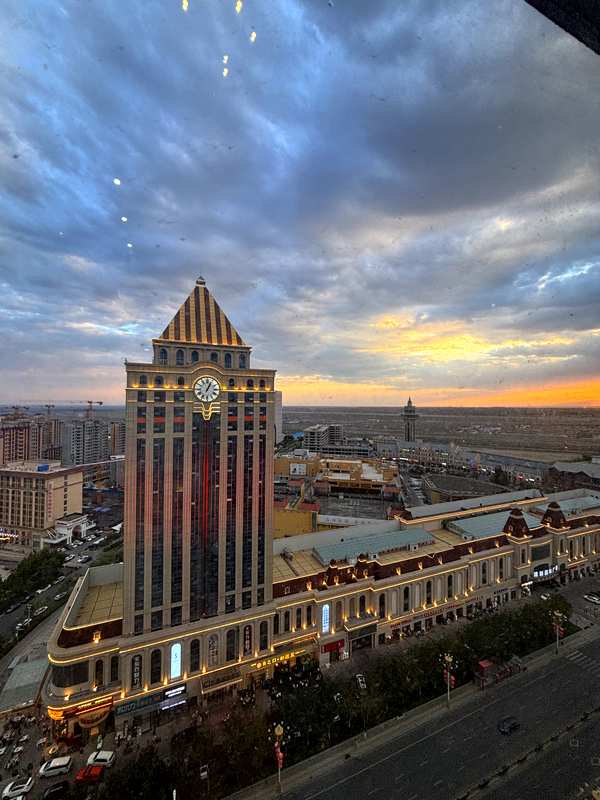
We stayed at a 163 CNY (23 USD) loft-style room in central Horgos with great city views, though our driver said a different, cheaper area nearby is actually a better pick. We checked into 霍尔果斯琪瑞大夏民宿 (Huò’ěrguǒsī Qíruì Dàshà Mínsù), a loft-style room in a tall building, for 163 CNY (23 USD) for the night. The location was great, with good views over the city. You can actually see Kazakhstan from the window, the desert visible beyond the buildings. The room itself was rough, though: a missing tap, a hole in the ceiling from old water damage, and a dodgy staircase. We wouldn’t recommend it unless you’re a backpacker after somewhere cheap with your own space.
Our driver recommended a different area for accommodation, one he called 62团 (62 Tuán), saying it’s cheaper and better than where we ended up. We’d already booked by the time we heard this, but it’s somewhere we’d consider next time.
We book accommodation on Trip.com in pretty much every city we stay in on this trip, Horgos included. It’s easier than juggling different local apps everywhere we go.
Visiting the China Kazakhstan Border Free Trade Zone
The China (Horgos) Pilot Free Trade Zone lets you walk right up to the China Kazakhstan border, though most of the shopping malls inside were empty, and prices matched what you’d pay on the Chinese side, with alcohol and cigarettes the one genuine exception.

Getting in means going through Chinese immigration and security, a real part of the experience in itself, not just paperwork. As foreign passport holders, we didn’t pay anything to enter or exit the cooperation centre itself. Chinese nationals need a permit from a nearby permit office to cross into the zone, 15 CNY (2 USD), using their ID, so it’s worth knowing this fee simply doesn’t apply if you’re travelling on a foreign passport. Once inside, getting around costs 2 CNY (0.30 USD) per person per trip on the internal white bus. We took two trips across the three of us, 12 CNY (1.70 USD) total.
Honestly, there wasn’t a whole lot to see or buy. A lot of the shopping centres we walked through were largely empty and didn’t seem to be selling much. Most of what’s on offer inside the zone, you can buy on the Chinese side for close to the same price anyway. The real difference is alcohol and cigarettes, where the tax breaks are genuinely significant.

The Duty-Free Rules That Actually Matter
If you’re planning your own visit, the zone runs on a real duty-free shopping quota: 8,000 CNY (about 1,120 USD) per visitor per day. That quota is worth more on imported goods that would otherwise carry import tax. It’s worth less on everyday items you could get just as cheaply back in a Chinese city.
China’s own customs rules also cap what you can bring back in duty-free: 1.5 litres of alcohol over 12% ABV and 400 cigarettes per person. Crossing the border more than once within 15 days drops your tobacco allowance sharply. These rules can change, so check current figures before you plan a shopping trip around them.
A note on which “Horgos” this is: our visit was a same-day excursion into the Free Trade Zone from the China side. Our passports got checked, but there was no international entry stamp involved, not a full border crossing into Kazakhstan. If you’re researching an actual crossing into Kazakhstan, or the reverse from Almaty, the visa and process are different from what we describe here. Double-check current entry rules for that specific route separately.

Fruit Market at the China Kazakhstan Border
A small fruit market sets up right outside the Free Trade Zone exit, a cheap, easy stop for fresh grapes and apples on the way back. As we exited the Free Trade Zone, we found a fruit market that had popped up outside. We picked up about half a kilo of purple grapes for 3 CNY (0.40 USD). Dad grabbed nine apples for around 10 CNY (1.40 USD).
Dinner at 情之口新疆菜 in Horgos
We ate at 情之口新疆菜, just opposite our accommodation, and had some of the best-value food of the whole trip, headlined by Dongxiang-style hand-grabbed lamb.

We had dinner there at around 8:00pm. The food was genuinely delicious and quite affordable. It was a nice change after a week mostly spent in tourist areas, where the food had been pricier and not always that good.

The standout dish was Dongxiang-style hand-grabbed meat (东乡手抓肉, Dōngxiāng shǒuzhuā ròu), 79 CNY (11 USD). It has a minimum order of 500g, priced at 158 CNY (22 USD) per kilo. It’s perfectly cooked, succulent lamb, delicious whether you eat it plain or with the dipping spices and raw onion. It might be one of our favourite ways they prepare lamb in Xinjiang. It’s right up there with the lamb soup served in a tin cup (缸子羊肉汤, gāngzi yángròu tāng) we’ve had elsewhere on this trip.

We also had stir-fried romaine lettuce (素炒油麦菜, sù chǎo yóumàicài) for 32 CNY (4.50 USD), simple but good, and a West Lake beef soup (西湖牛肉羹, Xīhú niúròu gēng) for 32 CNY (4.50 USD). It’s a Hangzhou-style soup made with Xinjiang spices, dill, and local beef. It came out in a giant bowl we couldn’t finish and was genuinely one of the better soups on the trip. The rice (米饭, mǐfàn), 3 CNY (0.40 USD), tasted like it had been cooked with lamb shank. Worth flagging, since not every rice order in Xinjiang is plain white rice cooked in water only.


Day 16 Costs: Bole to the China Kazakhstan Border
| Item | Cost (CNY) | Cost (USD) |
|---|---|---|
| 顺风车 ride-share, Bole to Horgos | 275 | 38 |
| Road tolls (14/person x 3) | 42 | 6 |
| Accommodation at 霍尔果斯琪瑞大夏民宿 | 163 | 23 |
| White bus in the Free Trade Zone (2 trips x 3 people) | 12 | 1.70 |
| Fruit (grapes and apples) | 13 | 1.80 |
| Dinner at 情之口新疆菜 | 146 | 20 |
| Total | ~651 | ~90 |
FAQ: Visiting the China Kazakhstan Border at Horgos
Is the Horgos Free Trade Zone worth visiting for duty-free shopping?
Only really for alcohol and cigarettes, where tax breaks are genuine. Most other goods cost about the same as on the Chinese side. A lot of the shopping centres inside were largely empty when we visited.
Do you need a Chinese phone number to book a ride-share to Horgos?
Only for the Amap carpool (顺风车, shùnfēngchē) service we used for this specific leg, which does require a Chinese phone number and Chinese-language use. It’s not essential for Didi, which is our most commonly used ride-share platform within China generally.
Are there facial scans and ID checks on the road to Horgos?
Yes, expect a couple of checkpoints where everyone winds down their windows for a facial scan. Foreigners get an occasional manual passport check too. It’s part of a movement-tracking system specific to Xinjiang, used entering and exiting cities within the province. You won’t run into it elsewhere in China.
How long is the Guozigou Bridge?
The bridge itself is 700 metres long, with a deck about 200 metres above the valley floor. The surrounding road section, including approaches, runs about 4.4 kilometres.
Do foreign travellers need to pay a permit fee to enter the Horgos Free Trade Zone?
No. The 15 CNY (2 USD) permit fee only applies to Chinese nationals, who need it from a nearby permit office to cross into the zone using their ID. Travelling on a foreign passport, we paid nothing to enter or exit the cooperation centre itself.




Leave a Reply